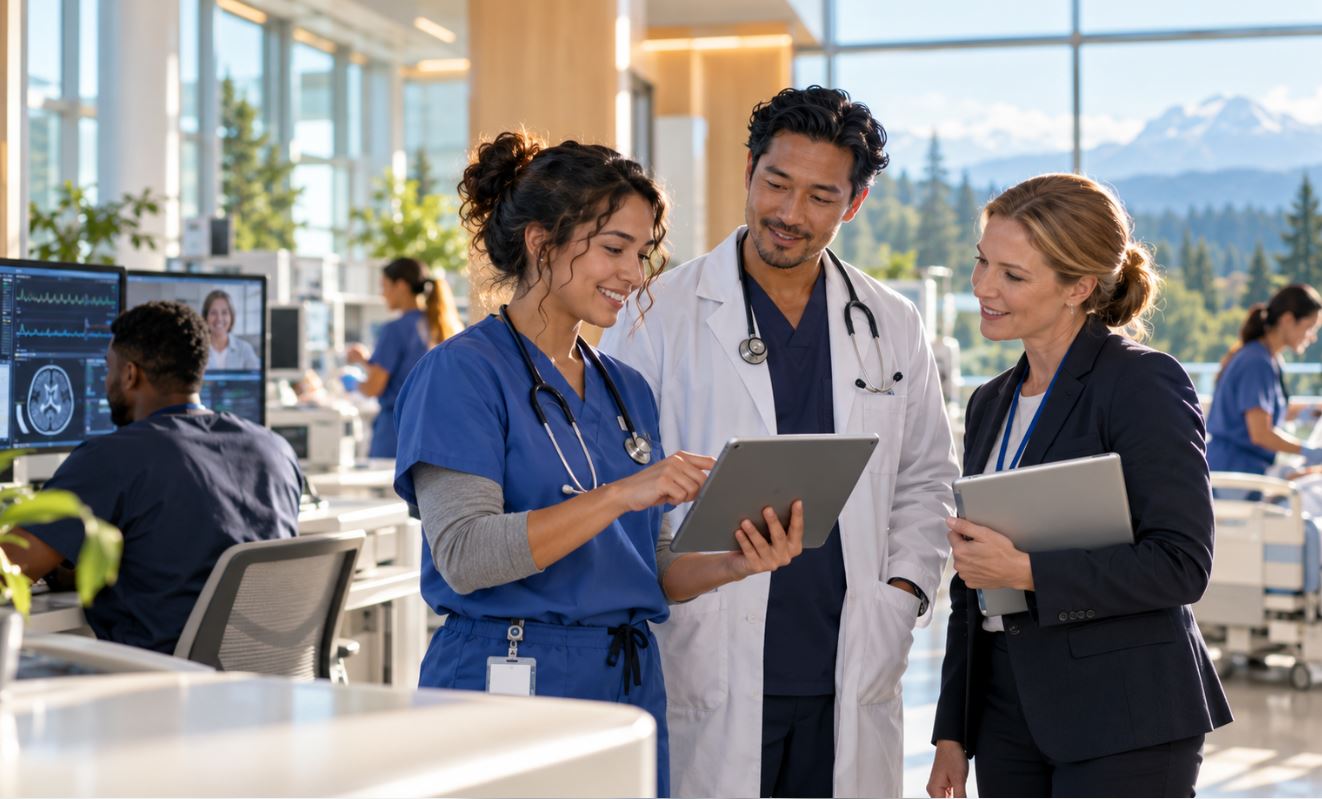
The healthcare industry is experiencing one of the most significant transformations in its history. From electronic health records and telehealth consultations to artificial intelligence and digital workforce management, technology is reshaping how healthcare professionals deliver care, develop their skills, and pursue career opportunities.
For registered nurses (RNs), licensed practical nurses (LPNs), certified medical assistants (CMAs), certified nursing assistants (CNAs), and caregivers in Oregon, this transformation brings both exciting possibilities and new professional expectations.
The future of healthcare is not simply about adopting advanced technology. It is about combining digital innovation with clinical expertise, compassion, and human connection.
As healthcare facilities across Portland and surrounding Oregon communities adapt to these changes, understanding the evolution of healthcare careers is becoming essential for professionals and employers alike.
How Technology Is Transforming Healthcare Careers
Traditionally, healthcare professionals relied heavily on paper records, manual scheduling, and face-to-face communication. Today, digital systems increasingly support these responsibilities, creating more connected healthcare environments.
Electronic health records (EHRs), for example, allow authorized professionals to document care, review medical histories, monitor treatment plans, and exchange information across care teams.
According to a 2025 federal health IT report, 99% of U.S. non-federal acute care hospitals enabled patients to electronically view their health information in 2024, while 92% offered secure patient-provider messaging.
These figures demonstrate how deeply digital communication has become integrated into modern healthcare delivery.
For healthcare workers, technological competence is therefore becoming an important complement to clinical knowledge. A nurse who understands electronic charting, a medical assistant who manages digital patient information, or a caregiver who uses approved care documentation tools can contribute to more coordinated healthcare services.
However, successful technology adoption requires proper training, reliable systems, and an ongoing commitment to patient privacy.
The Rise of Telehealth and Virtual Healthcare Careers
Telehealth has expanded opportunities for healthcare professionals to participate in patient care beyond traditional clinical settings.
Virtual consultations, remote patient monitoring, telephone triage, and digital chronic disease management can help appropriate patients receive healthcare services without always traveling to a medical facility.
The National Center for Health Statistics reported in June 2026 that 80% of U.S. office-based physicians used telemedicine in 2024.
Although utilization had declined from its pandemic-era peak, telemedicine remained an established part of healthcare delivery.
For Oregon, these developments are particularly relevant to communities where access to specialized healthcare services may require significant travel.
The Oregon Health Authority’s 2025 Health Care Workforce Needs Assessment specifically recommends increasing remote work and telehealth opportunities.
Healthcare professionals may encounter opportunities involving virtual patient education, remote clinical coordination, and technology-supported follow-up care, depending on their qualifications and scope of practice.
Nevertheless, telehealth does not eliminate the need for in-person healthcare. Technology should extend the reach of qualified professionals, not compromise clinical judgment or essential hands-on care.
Artificial Intelligence Is Changing Healthcare Responsibilities
Artificial intelligence is increasingly influencing how healthcare organizations analyze information, identify risks, and manage administrative responsibilities.
A federal health IT analysis found that 71% of surveyed U.S. non-federal acute care hospitals reported using predictive AI integrated with their electronic health records in 2024, compared with 66% in 2023.
Healthcare organizations use predictive technologies for purposes such as identifying patients at risk of deterioration, forecasting certain clinical outcomes, and supporting scheduling decisions.
For nursing professionals, these developments may introduce additional responsibilities involving the interpretation of digital alerts, recognition of inaccurate information, and appropriate escalation of patient concerns.
However, artificial intelligence is not a substitute for professional accountability.
An automated alert cannot independently replace a nurse’s clinical assessment, ethical reasoning, or understanding of an individual patient’s circumstances.
Healthcare employers must also consider potential algorithmic bias, data quality, transparency, and patient safety when introducing these technologies.
The professionals who thrive in this environment will be those who understand both the capabilities and limitations of digital healthcare tools.
Healthcare Career Opportunities Are Expanding in Oregon
Despite rapid technological advancement, the demand for skilled healthcare professionals remains substantial.
The U.S. Bureau of Labor Statistics projects the following national employment growth between 2025 and 2035:
- Registered Nurses: 6% employment growth.
- Medical Assistants: 13% employment growth.
- Home Health and Personal Care Aides: 18% employment growth.
These are national projections rather than Oregon-specific forecasts, but they illustrate the continuing need for healthcare expertise.
Oregon’s own outlook is also significant.
The state’s Future Ready Oregon annual report projects approximately 13% employment growth in healthcare and social assistance from 2023 to 2033, representing more than 37,000 additional jobs.
These projections reflect broader healthcare workforce needs, including an aging population, ongoing demand for medical services, and the replacement of workers leaving existing positions.
For professionals considering healthcare careers in Oregon, the expanding industry offers potential pathways across hospitals, outpatient clinics, nursing homes, skilled nursing facilities, and home healthcare settings.
Digital competence can strengthen a candidate’s readiness for these opportunities, although appropriate education, experience, and professional credentials remain fundamental.
Five Essential Digital Skills for Modern Healthcare Professionals
As healthcare technology advances, professionals should prioritize practical skills that support safe and effective patient care.
1. Electronic Health Record Proficiency
Understanding how to navigate EHR systems, document accurately, and locate relevant patient information helps healthcare workers transition between clinical environments.
2. Digital Communication
Secure messaging, virtual consultations, and electronic handovers require clear communication, professionalism, and an understanding of approved communication channels.
3. Data Privacy and Cybersecurity Awareness
Healthcare workers must recognize the importance of protecting patient information, using authorized systems, and following applicable privacy requirements.
4. Digital Clinical Awareness
Professionals should understand how technology-assisted alerts and electronic information contribute to care decisions while recognizing when human assessment is necessary.
5. Adaptability and Continuous Learning
Because healthcare software and procedures evolve, a willingness to learn new systems is becoming increasingly valuable.
Importantly, digital training must remain appropriate to each professional’s responsibilities. The technological expectations placed on an RN may differ considerably from those of a CNA or caregiver.
How Digital Technology Is Transforming Healthcare Recruitment
Digital transformation is also changing how healthcare professionals discover employment opportunities and how facilities recruit qualified personnel.
Online job applications, electronic credential verification, digital interviews, and workforce scheduling systems can simplify different stages of recruitment.
In Oregon, the Oregon State Board of Nursing provides an online primary-source verification system containing real-time nursing and nursing assistant credential information.
Such resources support credential checking, although employers must still conduct appropriate screening and confirm that candidates meet position-specific requirements.
For healthcare professionals, digital recruitment offers greater visibility into available positions and potentially more efficient application processes.
For employers, well-managed digital systems can improve coordination when filling shifts, assessing qualifications, and onboarding new personnel.
However, successful healthcare recruitment involves more than matching qualifications to job descriptions.
Professional competence, communication, reliability, workplace compatibility, and commitment to patient care remain essential considerations.
Preparing Oregon’s Healthcare Workforce for the Future
While digital healthcare offers considerable advantages, its implementation also presents challenges.
Healthcare professionals may encounter unfamiliar software, increased documentation requirements, inconsistent training, and concerns about technology-related workload.
Facilities may face difficulties associated with system integration, cybersecurity, staff readiness, and financial investment.
To address these challenges, Oregon healthcare employers should prioritize structured technology orientation, continuing education, accessible technical support, and clear clinical protocols.
Healthcare professionals can prepare by actively developing digital skills, maintaining their credentials, and seeking employers that value professional growth.
Ultimately, the most effective healthcare environments will be those that adopt useful technologies without neglecting the people responsible for delivering care.
How Dino Health Supports Modern Healthcare Careers in Oregon
At Dino Health Staffing, we recognize that the future of healthcare depends on professionals who combine clinical competence, adaptability, and genuine compassion.
As a nurse-led healthcare staffing agency with over 30 years of combined clinical experience, we understand the evolving expectations placed on healthcare workers and the facilities that depend on them.
We connect qualified RNs, LPNs, CMAs, CNAs, and caregivers with healthcare facilities in Portland and surrounding Oregon communities.
Through our per diem, contract, and permanent staffing solutions, we help healthcare organizations access qualified professionals while supporting individuals seeking meaningful employment opportunities.
We believe that even as technology changes how healthcare is delivered, the dedication, knowledge, and compassion of healthcare professionals remain irreplaceable.
Conclusion: The Future of Healthcare Remains Human
The evolution of healthcare careers in a digital world represents an important opportunity for Oregon’s healthcare workforce.
Electronic health records, telehealth, artificial intelligence, and digital recruitment are changing professional expectations and creating new possibilities for healthcare delivery.
Yet technology alone cannot build strong healthcare teams or guarantee quality patient care.
The future belongs to professionals and organizations that successfully balance technological innovation with clinical excellence, accountability, and human connection.
Are you ready to advance your healthcare career or strengthen your facility’s workforce?
Explore opportunities through Dino Health Staffing or request qualified healthcare staff to support your organization’s evolving needs.
Dino Health is dedicated to connecting healthcare professionals with top-tier job opportunities while ensuring healthcare facilities find the best talent. We are committed to enhancing the healthcare industry by prioritizing work-life balance, career growth, and professional well-being. Through expert insights, industry news, and career resources, we empower nurses, doctors, and allied health professionals to thrive in their careers. Connect with Us on Facebook